


Cataract Surgery in
Provo, Utah
Our surgeons provide advanced cataract surgery and customized lens options to help patients restore clearer vision, improve daily activities, and enjoy greater visual freedom.
Clear Vision Starts Here:
Advanced Cataract Care
at Utah Valley Eye
Cataract Surgery in Provo, UT
Cataracts gradually cloud and dim your vision, but at Utah Valley Eye Center, advanced lens technology and decades of surgical expertise restore clear sight by replacing the eye’s cloudy lens with a precise artificial one—often reducing dependence on glasses.
KNOW THE SIGNS
What Is a Cataract?
A cataract occurs when the natural lens inside the eye becomes cloudy, causing vision to appear blurry, hazy, dim, or less vibrant over time. Cataracts are a normal part of aging and affect millions of Americans each year. The good news is that cataract surgery can restore clearer vision and help patients return to the activities they enjoy most.
What Are the Symptoms of Cataracts?
Common symptoms include:
✓ Cloudy, blurry, or dim vision
✓ Difficulty driving at night
✓ Sensitivity to light and glare
✓ Halos around lights
✓ Colors appearing faded or yellowed
✓ Needing brighter light to read
✓ Frequent changes in your glasses prescription
If cataracts begin interfering with daily activities such as reading, driving, or working, cataract surgery may be recommended.
How Are Cataracts Treated?
Cataract surgery is the only effective treatment for cataracts. During the procedure, the cloudy natural lens is removed and replaced with a clear artificial lens called an intraocular lens (IOL). Modern lens options can also help reduce dependence on glasses for some patients.
Step 1: Evaluation
Step 1: Evaluation
Step 2: Lens Selection
Step 3: Surgery
Step 3: Surgery
Step 4: Recovery
Step 3: Surgery
Am I Ready for Cataract Surgery?
Many people wonder when they are “ready” for cataract surgery. The answer usually depends on how much the cataract is affecting your everyday life. When vision changes begin to interfere with activities like driving, reading, working on a computer, or enjoying hobbies, it may be time to consider surgery.
You may be a candidate for cataract surgery if you experience:
- Blurry or cloudy vision that glasses can no longer fully correct
- Difficulty driving at night due to glare or halos around lights
- Increased sensitivity to bright light or headlights
- Colors appearing faded or yellowed
- Vision changes that make reading or everyday tasks more difficult
Cataract surgery is typically recommended when the cataract begins affecting your quality of life rather than based on a specific age or stage of the cataract.
A comprehensive cataract evaluation allows your surgeon to examine your eyes, confirm that a cataract is the cause of your vision changes, and discuss the best treatment options for your vision goals.
Want To Know If Cataract Surgery Is Right For You?
Your Lens Options for Cataract Surgery
One of the most important decisions you will make about cataract surgery is choosing your intraocular lens, or IOL. This is not a one-size-fits-all decision. The best lens for you depends on your lifestyle, vision goals, overall eye health, and how much you want to reduce your dependence on glasses after surgery.
At Utah Valley Eye Center, we offer the full range of IOL options, from standard covered lenses to the most advanced premium technology available today. Your surgeon will review all options with you at your pre-operative appointment and make a personalized recommendation based on your eyes and your goals.
Which Lens Is Right for You?
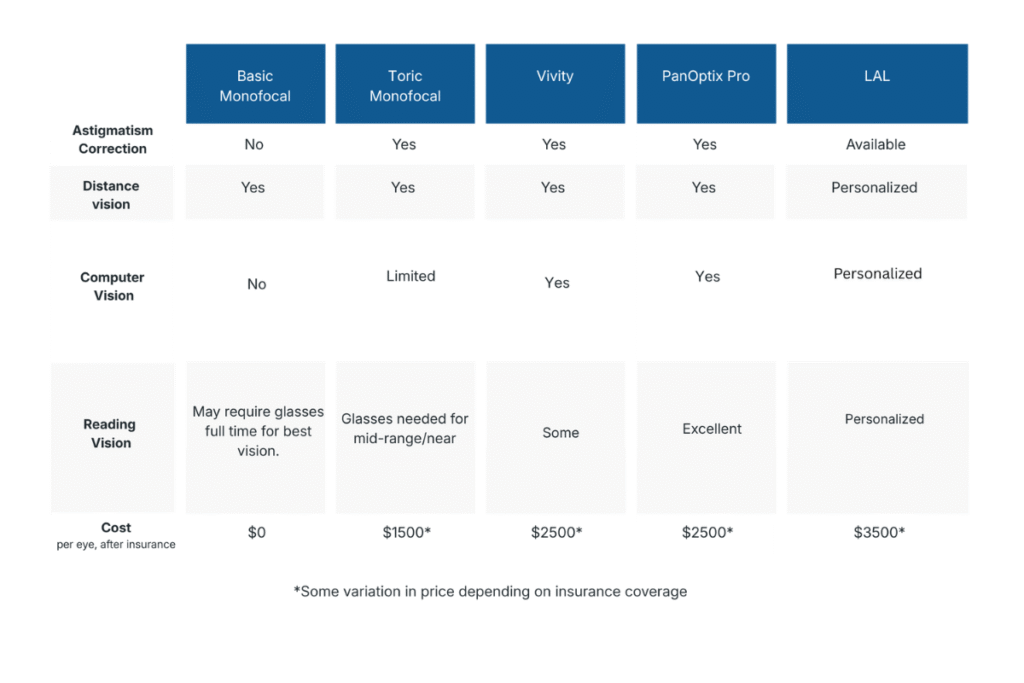
IOL Comparison Chart:
The chart below provides a side-by-side look at your lens options. The best choice ultimately depends on your individual eye health, daily activities, and how much freedom from glasses you hope to achieve. Your surgeon will help you weigh these factors during your consultation.
Our Cataract Surgeons
Our cataract surgeons perform advanced cataract surgery using modern diagnostic technology and customized lens options to help patients achieve their vision goals.
Your surgeon will personally perform your evaluation, review your lens options, and oversee your care throughout your surgical journey. You can feel confident knowing your procedure is performed by an experienced cataract surgeon dedicated to your outcome.
Patients Story
Loved by our Patients
Cataract Surgery
Frequently Asked Questions.
Most patients are ready for cataract surgery when their vision begins affecting daily life. Common signs include difficulty driving at night, trouble reading, increased glare, or needing more light for routine activities.
During your eye exam, your doctor will measure your visual acuity and evaluate the severity of your cataract.
The surgery itself takes approximately 20-30 minutes. Plan on being at the surgery center for about 2 hours to allow time for preparation, the procedure, and a brief recovery period before you are discharged.
No. Each eye is scheduled separately, typically about 1-2 weeks apart. This approach allows the first eye to heal properly before proceeding with the second eye.
Most patients return to light activities the day after surgery. Vision may be slightly blurry for a few days as the eye heals.
You will use prescribed eye drops for several weeks. Swimming pools, hot tubs, and lakes should be avoided for 2 weeks. Heavy lifting and strenuous exercise are usually restricted for about one week.
Yes. Prior LASIK does not disqualify you from cataract surgery, but it does require additional measurements and calculations to ensure accurate lens selection. An ORA (intraoperative aberrometry) scan may also be used during your procedure to confirm measurements in real time.
Whether you need glasses after cataract surgery depends on the intraocular lens you choose.
With a standard monofocal lens, most patients still need glasses for either distance or reading. With premium lens options such as PanOptix Pro, many patients achieve significant independence from glasses. Some may still choose glasses occasionally for small print or low-light conditions.
Your surgeon will provide personalized expectations based on your eye health and lens selection.
Your IOL is designed to last the rest of your life. Once implanted, it does not need to be replaced and you will never have another cataract in that eye.
Some patients develop clouding of the membrane behind the intraocular lens weeks, months, or years after surgery. This is called posterior capsular opacification, or PCO.
PCO is not a new cataract. It is a separate condition that can be treated with a quick, painless in-office laser procedure called a YAG capsulotomy. The treatment takes only a few minutes and typically restores clear vision immediately.
Cataract surgery is not painful. The procedure is performed using local anesthesia with mild IV sedation to keep you relaxed and comfortable. You may feel light pressure, but you should not experience pain. Any mild irritation afterward is usually managed with over-the-counter medication.
The cost of cataract surgery varies depending on your insurance coverage and the lens you select.
Medicare and most insurance plans cover the medically necessary portion of surgery with a standard monofocal lens. Premium lens options involve an additional out-of-pocket investment.
Before scheduling surgery, our team will review your insurance benefits and provide a clear estimate so you understand your costs in advance.
Call 801-357-7373 or request an appointment online to schedule your cataract evaluation.
Ready to Schedule Your Appointment?
If you’ve been diagnosed with cataracts or are experiencing changes in your vision, our team is here to help.